If you’ve scrolled LinkedIn in the past month, you’ve seen the headline: 36% of UK employers have cut entry-level jobs in the last year, and 43% of firms blame AI for it. It’s been picked up widely since Reuters covered the Work Foundation’s survey in late August, and if you’re hiring or job-hunting in sales, it lands like a direct hit on the SDR role — the classic entry point into a B2B sales career.
Here’s the part that didn’t make as many headlines: in the same UK data, Sales Development Representative roles grew by 17% and Business Development Representative roles by 16%, among the entry-level job titles actually expanding. Retail Assistant led the pack at +25%. So which is it? Is the SDR job dying, or is it one of the few entry-level roles holding up?
The honest answer is both, depending on where you’re looking. Here’s what the numbers actually say, and what they mean if you’re hiring SDRs or trying to become one.
The headline everyone shared
The Work Foundation, part of Lancaster University, commissioned Survation to survey 1,001 senior UK business leaders in May 2026. The results, reported by Reuters on 26 August 2026, found that 36% of employers had reduced entry-level roles for 16-24 year-olds over the previous 12 months, and that 43% of firms cited AI or automation as a factor in that reduction. The effect wasn’t evenly spread: only 24% of small firms pointed to AI, against 58% of medium-sized firms and 60% of large ones.
That’s a real, well-sourced finding, and it’s exactly the kind of story that spreads fast because it confirms what a lot of people already suspected. The trouble is that “entry-level jobs” is doing a lot of work in that headline, and it covers everything from data entry to retail tills to junior sales. Not every entry-level function is being squeezed the same way, and the size of the effect varied sharply by employer size too — a lot of the contraction looks like it’s coming from bigger organisations restructuring functions at scale, rather than a uniform shift across every UK employer.
The part that got buried: SDR and BDR roles grew
Reported alongside the same coverage, UK entry-level job postings told a different story for a handful of roles: Sales Development Representative up 17% and Business Development Representative up 16%, both among the strongest growth categories, behind only Retail Assistant. That’s a genuinely useful data point for anyone hiring junior sales talent right now — at a national level, the SDR function isn’t shrinking. It’s one of the more resilient entry points into work in a year when entry-level hiring overall is under real pressure.
If your instinct from the LinkedIn headlines was to quietly shelve your SDR hiring plans, this is the bit worth knowing before you do.
But look inside B2B SaaS specifically, and it’s tighter
Zoom into technology and SaaS sales — SRUK’s own specialism — and the picture changes again. Emergence Capital and Benchmarkit’s “Beyond Benchmarks 2025” survey of more than 560 B2B SaaS companies found SDR and BDR hiring down roughly 21% year-on-year across the sector. Of those companies, 36% had reduced SDR/BDR headcount over the period, 19% had increased it, and 44% had left it unchanged.
So the two datasets aren’t actually contradicting each other. They’re describing different populations. Across the whole UK economy, junior sales roles are growing. Inside SaaS specifically, where AI sales tooling has matured fastest and outbound motion has been squeezed hardest by buyer fatigue and tighter budgets, SDR headcount has genuinely contracted.
The real story: the role is splitting, not disappearing
Sitting inside that SaaS contraction is a third, sharper trend. Analysis of real-time GTM job postings (Growth Unhinged, using Sumble data) found that AI-native companies more than doubled their SDR headcount in the first half of 2026, with AI-native go-to-market hiring up nearly 50% year-on-year. They’re still small in absolute terms — roughly 5% of digital-native GTM job postings and about 2% of GTM headcount — but the direction is unmistakable: the fastest-growing companies in tech are hiring SDRs aggressively, at the same time as the median SaaS company is cutting them.
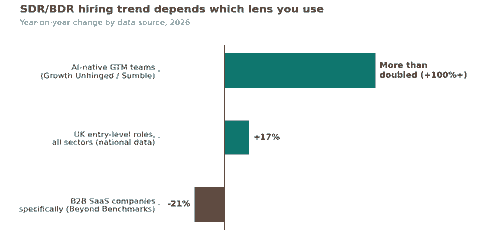
| Lens | SDR/BDR hiring trend | Source |
|---|---|---|
| UK entry-level roles, all sectors | +17% (SDR), +16% (BDR) | UK jobs data, reported alongside Work Foundation/Survation survey, Aug 2026 |
| B2B SaaS companies specifically | -21% year-on-year | Emergence Capital & Benchmarkit, “Beyond Benchmarks 2025” (560+ companies) |
| AI-native GTM teams | More than doubled in H1 2026 | Growth Unhinged / Sumble job postings analysis |
Put together, this isn’t “AI is killing the SDR job.” It’s a redistribution. The volume-based, high-activity outbound grind that AI sequencing and enrichment tools now do faster and cheaper is being automated out of the traditional SaaS SDR job. The judgement-heavy work — multi-threading a target account, personalising outreach that actually lands, qualifying complex buying committees, running discovery that AI can’t fake — is where the growth is, and it’s concentrated in the companies building and using AI aggressively rather than fighting it.
Why SaaS specifically got squeezed first
It’s not a coincidence that this shows up hardest in B2B SaaS. Two things came together at once. First, SaaS sold outbound sequencing and enrichment tools to everyone else for years before turning those tools on its own sales org, so the automation was mature and cheap well before other sectors caught up. Second, SaaS buyers have been the most fatigued audience in B2B for a while now — inboxes full of near-identical “quick question” templates — which meant the low-effort, high-volume version of the SDR job was already producing worse returns before AI made it easier to automate away. Sectors with less outbound saturation, and less mature AI tooling of their own, haven’t hit that same wall yet, which is a large part of why the national picture still looks healthy.
There’s a compounding effect worth flagging too. AI-native firms more than doubling headcount are still a small slice of overall GTM postings, so the national “+17%” figure isn’t being carried by a handful of outliers — it reflects genuine breadth across ordinary employers outside the SaaS contraction.
What this means if you’re hiring SDRs
Three practical takeaways for anyone building a junior sales team right now:
- Don’t shelve entry-level sales hiring because of a headline about entry-level jobs in general. At a national level, SDR and BDR roles are growing, not shrinking. The risk is concentrated in one sub-sector, not the function itself.
- Rewrite the job description before you rewrite the headcount. The version of the SDR job that’s contracting is the one built entirely around dial volume and generic sequences. The version that’s growing is built around judgement, research and personalisation, with AI tools handling the grunt work underneath it.
- Pair the hire with the tooling, don’t choose between them. The companies doubling SDR headcount aren’t doing it instead of using AI. They’re doing it because AI has freed the role up to focus on the parts that actually move a deal forward, and they need more people who can do that well.
Spotting the difference in a job ad
Whichever side of the hiring table you’re on, the job ad itself is usually a decent tell.
- Language built around activity targets (“80 dials a day”, “150 emails sent”) tends to describe the version of the role under the most pressure — it’s measuring the part AI now does faster.
- Language built around outcomes and judgement (“book qualified meetings with the right stakeholders”, “research and personalise outreach to named accounts”) tends to describe the version that’s growing, because it’s measuring the part a person still has to do.
- Any mention of AI tooling as part of the stack — sales engagement platforms, intent data, AI-assisted research — is usually a signal the company has already restructured the role around the split described above.
If your draft still reads like a dialler-metrics job from five years ago, candidates who’ve done their homework on this trend will read it as a warning sign, not a selling point.
Building or restructuring a junior sales team? If your last SDR hire didn’t work out, the problem is often the role definition, not the person. We can help you get the brief right before you’re back in the market.
What this means if you’re an SDR, or want to become one
If you’re already in the role, or targeting it as your way into B2B sales, the data points the same direction as the advice above. Fluency with AI sales tools is increasingly table stakes, not a threat to your job — it’s what frees you up to do the parts of the role that actually get you promoted. Candidates who can show they’ve used AI to work smarter — better account research, sharper personalisation, faster qualification — rather than candidates who ignore it or fear it, are the ones getting hired into the roles that are genuinely growing.
It’s also worth being deliberate about where you apply. The data suggests SDR opportunities are more plentiful outside the median SaaS company right now, and concentrated in businesses that are visibly investing in AI-assisted outbound rather than treating it as optional. Sectors covered in our 2026 UK Sales Salary Guide outside pure SaaS are a reasonable place to start looking.
What to do next
- Review your SDR job spec against what’s actually growing — judgement and personalisation, not raw activity volume.
- Check what AI tooling your team has, or doesn’t have, before assuming you need fewer people rather than differently-skilled ones.
- If you’re hiring, benchmark the role against sectors outside SaaS where entry-level sales hiring is holding up better.
- If you’re job hunting, be ready to talk specifically about how you’ve used AI tools in a sales context, not just that you’ve heard of them.
Whichever side of the hiring table you’re on, understanding which of these trends actually applies to your sector matters more than reacting to the headline. The “AI is killing entry-level jobs” story is real in places, but treating it as a blanket verdict on sales hiring means either walking away from one of the more resilient entry points into a B2B career, or writing a job ad for a version of the SDR role that’s already on its way out.
Frequently asked questions
Is the SDR role becoming obsolete?
No, not at a national level. UK entry-level SDR and BDR job postings grew in the past year. What’s changing is the shape of the role: less pure activity volume, more judgement, research and personalisation, with AI tools handling routine prospecting tasks.
Is this just a SaaS problem, or does it affect all sectors?
The contraction is concentrated in B2B SaaS specifically, where AI sales tooling has matured fastest. Outside SaaS, entry-level sales roles are one of the more resilient categories in a UK jobs market where entry-level hiring overall is under pressure.
Which companies are still hiring SDRs?
The clearest growth is among AI-native companies, which more than doubled SDR headcount in the first half of 2026. More broadly, companies actively investing in AI-assisted outbound tooling appear to be adding headcount rather than cutting it.
Should I mention AI tools in a sales job interview?
Yes. The data suggests employers are hiring for SDRs who can use AI to work smarter, not candidates who avoid it. Being specific about how you’ve used AI for research, personalisation or qualification is a genuine differentiator right now.
How reliable is this data?
It’s a mix of a formally commissioned survey (Work Foundation and Survation, 1,001 senior business leaders) and job-postings analysis from industry sources (Emergence Capital and Benchmarkit’s SaaS-specific survey, and Growth Unhinged’s analysis of live GTM postings). None of it is a full census of the UK jobs market, but a formal employer survey, a large sector-specific study and independent postings data all pointing the same direction is about as solid a signal as this kind of trend gets before it’s fully settled.
Hiring sales talent, or looking for your next SDR or BDR role? We place specialist sales professionals across the UK and know which sectors are actually growing right now.
Hiring SDRs in Technology & SaaS? See our technology sales recruiters, the Technology & SaaS sales salary benchmarks, the SDR & BDR salary benchmarks, or our Scotland sales recruitment team.
Looking for your next move in sales rather than hiring? Browse our current sales roles.
This article draws on third-party survey and job-postings data as reported by Reuters, Work Foundation/Survation, Emergence Capital & Benchmarkit, and Growth Unhinged. Figures are as reported by those sources at the time of writing.